

What Happens in a Professional Duct Cleaning Process?
- coolbreezelv
- 16 hours ago
- 6 min read
If you have ever looked at a vent cover and seen a layer of dust building up again just days after cleaning, it is fair to wonder what is sitting deeper in the system. The professional duct cleaning process is designed to remove that hidden buildup from supply ducts, return ducts, registers, and key HVAC components without spreading debris through your home or business.
For property owners in dry climates, that question comes up even more often. Fine dust, sand, pollen, pet dander, and construction debris do not just settle on furniture. They can collect inside ductwork over time, especially when filters are overdue, airflow is restricted, or a building has recently been remodeled. A proper cleaning is not a quick vacuum at the vent opening. It is a controlled, system-wide service with inspection, containment, agitation, extraction, and verification.
What the professional duct cleaning process should include
A quality duct cleaning starts before any hose is turned on. The technician should first inspect the system, identify the type of ductwork, and look for problem areas such as heavy buildup, disconnected sections, damaged insulation, mold-like growth, pest contamination, or weak airflow. This matters because not every HVAC system should be cleaned the same way. Flexible ducts, metal ducts, older duct board, and commercial systems all require a slightly different approach.
At this stage, a good company should also explain what will be cleaned and what will not. That conversation is where honest service shows up. Some systems need a full-source removal cleaning. Others may also need vent cover washing, blower compartment cleaning, or dryer vent service handled separately. If a contractor promises a whole-house cleaning in an unrealistically short visit, that is usually a sign the work will be superficial.
Step 1: System inspection and job setup
The first hands-on part of the job is setup. Technicians protect floors and nearby surfaces, then access the duct system in a way that supports negative pressure throughout the cleaning. In plain terms, they create a controlled pull of air so loosened debris moves toward the collection equipment instead of back into the living or working space.
This step often includes removing registers and grilles, checking the air handler, and cutting service openings where needed to connect professional vacuum equipment. Those access points should be made carefully and sealed properly once the work is done. Good setup is one of the biggest differences between a true duct cleaning and a rushed service.
Step 2: Creating negative pressure
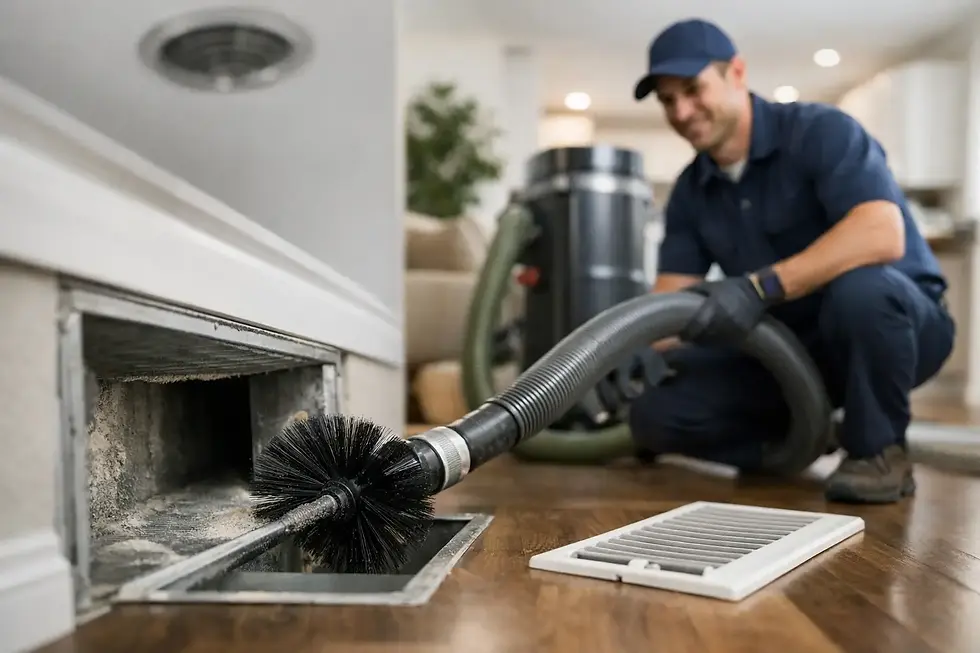
Negative pressure is the backbone of the professional duct cleaning process. A high-powered vacuum system, often truck-mounted or connected through commercial-grade portable equipment, pulls air and debris through the duct network. That constant suction helps contain dust while the technician works through each branch line.
This is where equipment quality matters. Household vacuums and small shop vacs are not built for full HVAC cleaning. They may pick up loose dust near an opening, but they do not have the power or filtration needed to handle debris deep in the system. Professional machines are designed to remove fine particles while keeping the indoor environment protected during the service.
Step 3: Agitating debris inside the ducts
Once the system is under negative pressure, technicians use specialized tools to dislodge buildup from inside the duct walls. Depending on the duct material and layout, this can include rotating brushes, compressed air whips, skipper balls, air snakes, or other agitation tools designed for source removal.
The key here is matching the method to the duct. Metal ductwork can usually tolerate more aggressive mechanical cleaning. Flexible ducting and duct board require a gentler approach to avoid damage. That is why training and experience matter. The goal is to remove contamination, not tear up the system in the process.
In homes and buildings across Las Vegas, this step often pulls out more fine desert dust than people expect. Even when vents look fairly clean on the surface, deeper sections can hold years of buildup that affect airflow and keep particles circulating.
Step 4: Cleaning supply ducts, return ducts, and vents
A proper job does not focus on only one side of the system. Supply ducts deliver conditioned air into rooms, while return ducts pull air back to the HVAC unit. If only the supply side is cleaned, dust and debris can continue moving through the returns and back into circulation.
Each vent opening should be addressed as part of the larger system, not treated as a standalone cleaning point. Registers and grilles are typically removed, cleaned, and reinstalled. Branch lines are cleaned one by one so the technician can move contamination toward the vacuum source in a controlled way.
This can be a slower process in larger homes, multi-unit properties, and commercial buildings, but that is not a bad sign. Thorough duct cleaning takes time because every section needs attention.
Step 5: Cleaning key HVAC components
Ducts are only part of the airflow system. If the blower compartment, evaporator area, or other accessible HVAC components are coated in dust, the system can still struggle even after the ducts are cleaned. That is why many professional services include or recommend cleaning related components that directly affect airflow and indoor air quality.
This is also where trade-offs come in. Not every appointment includes deep HVAC mechanical cleaning, and not every system needs the same level of service. If there is heavy buildup on components, the technician should explain the condition clearly and recommend the right next step instead of bundling vague add-ons.
For customers focused on efficiency, this part matters. Dust on moving parts and airflow-related components can force the system to work harder, which may raise energy use and increase wear over time.
Step 6: Optional sanitizing or deodorizing
Some customers ask whether ducts should be sanitized after cleaning. The answer is, it depends. If there has been odor, contamination, or a verified issue that calls for treatment, an environmentally safe product may make sense. But sanitizing should never be used to cover up poor cleaning or sold as an automatic extra.
A trustworthy technician should explain why a treatment is being recommended, what product is being used, and whether it is appropriate for the system and occupants. For homes with children, pets, allergies, or respiratory concerns, that transparency matters.
How to tell if the work is being done right
The biggest sign of quality is process, not sales language. A reputable provider will inspect the system, explain the scope, use professional containment and extraction equipment, and clean the full network in a methodical way. Before-and-after photos can also help verify results, especially in larger systems where customers cannot see every section themselves.
You should also expect plain communication. If there are damaged ducts, disconnected runs, signs of moisture, or issues that cleaning alone will not fix, you should hear that clearly. Duct cleaning can improve cleanliness, airflow, and HVAC performance, but it is not a cure-all for every indoor air problem.
Why this process matters in desert conditions
In Southern Nevada, airborne dust is part of daily life. Even well-kept properties deal with dry particles that make their way indoors through doors, windows, foot traffic, and HVAC cycling. Over time, those particles settle into ductwork, especially when filters are not changed consistently or the system has leaks.
That makes routine inspection and periodic cleaning more relevant here than in milder climates. Cleaner ducts can help reduce circulating dust, support better airflow, and lower strain on heating and cooling equipment that already works hard through long summers. For businesses, it can also support a cleaner environment for employees, customers, and tenants.
When to schedule service
There is no single schedule that fits every property. A newer home with good filtration and regular maintenance may need cleaning less often than an older property with pets, smokers, renovation dust, or heavy occupancy. Commercial spaces, especially those with continuous HVAC use, often need more frequent attention.
If you notice persistent dust, musty odor, weak airflow, worsening allergy symptoms indoors, or debris blowing from vents, it may be time for an inspection. The same goes for move-ins, post-construction cleanup, or situations where you are trying to improve HVAC performance before peak cooling season.
At Cool Breeze LV LLC, that conversation starts with a clear explanation of what your system needs and what it does not. A free estimate is often the best first step because it gives you a real picture of the duct condition before any work begins.
A good duct cleaning should leave you with more than cleaner vent covers. You should feel confident that the air moving through your home or building has a cleaner path, your HVAC system is not fighting through unnecessary buildup, and you have a clearer sense of how to protect indoor air going forward.


Comments